
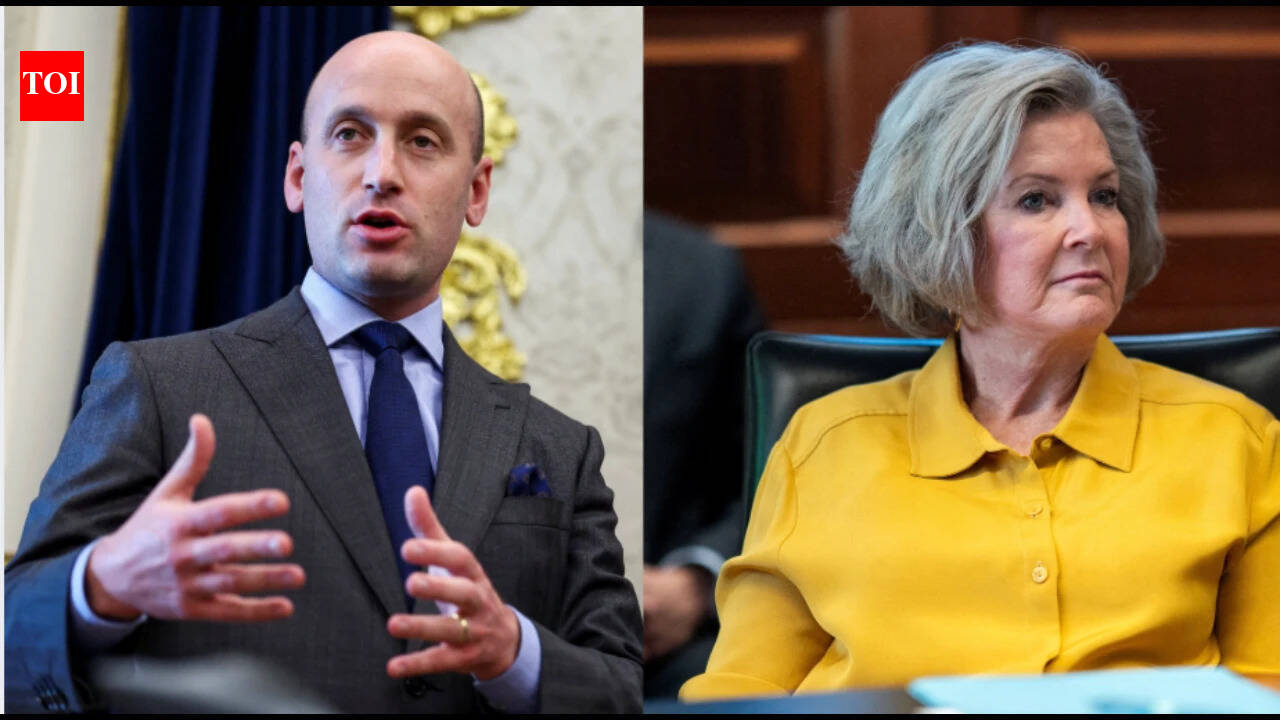
Stephen Miller makes his first big decision, internal memo reveals something Susie Wiles would have never approved: Report
Stephen Miller, the architect of some of the administration's most restrictive immigration policies, has reportedly made his first significant structural move inside the White House by circulating an internal memo that would redraw the balance of power between the West Wing and federal agencies, according to media reports. The memo, which has not been publicly released in full, is said to outline changes to the White House hierarchy that would grant Cabinet secretaries greater control over their departments' operations and personnel decisions. Reports describing the document suggest it diverges sharply from the management philosophy associated with Susie Wiles, the chief of staff, whose approach has emphasized discipline, centralized coordination, and tightly managed lines of authority. The reported proposal has therefore surfaced as an early test of how much influence Miller will wield over internal governance, an area where Wiles has been seen as the decisive voice.
The context of the reported memo lies in the long-running tension in any White House between ideological advisers who want aggressive action and operational staff who prioritize message discipline and institutional order. Miller, a senior adviser with a long record of shaping immigration and enforcement policy, has generally been associated with the more assertive wing of the administration. Wiles, by contrast, built a reputation during the campaign and the transition for insisting that decisions flow through a structured process and that Cabinet officials operate within clearly defined bounds. The reported memo therefore touches on a sensitive question: whether policy priorities should be driven from the center or devolved to departments. Because the document was circulated internally rather than announced publicly, much of what is known comes from secondary reports rather than official statements.
The key details that are well established are limited, and the White House has not offered a detailed public account of the memo's contents. Reports indicate that the proposed changes would expand the latitude of Cabinet secretaries in managing their agencies, potentially loosening some of the coordinating controls that the chief of staff's office has favored. It is not clear from public reporting whether the memo represents a formal policy directive, a discussion draft, or a proposal intended to prompt internal debate. What is clear is that the document has been characterized in press accounts as something Wiles would not have approved, a framing that underscores the appearance of a rift rather than a settled arrangement. Officials have not confirmed the precise scope of the changes, and no timeline for implementation has been publicly disclosed.
Reactions have so far been muted on the record, with neither Miller nor Wiles issuing public statements about the reported memo. The implications, however, are significant for how the administration governs: shifting authority toward Cabinet secretaries could accelerate policy rollouts favored by departments but complicate efforts to maintain a unified message. It could also alter the daily working relationships between agency heads and the White House liaison staff who typically monitor departmental decisions. Allies of the chief of staff have historically stressed that clear chains of command prevent costly internal conflicts, while advocates of decentralization argue that empowered secretaries move faster. The episode has also drawn attention from political observers who see it as an early signal of how competing power centers will operate.
In broader terms, the reported memo fits a familiar pattern in which administrations debate whether the White House should act as a clearinghouse for major decisions or as a strategic center that delegates execution. This debate intensifies whenever an administration pursues ambitious regulatory or enforcement goals, because departments must act and the White House wants coherence. Centralized control can slow initiatives but limits embarrassing missteps, while devolved authority can produce speed at the cost of coordination. The reported proposal also arrives amid ongoing scrutiny of how the administration manages its agencies and communicates policy. How this internal question is resolved may shape not only personnel dynamics but also the pace of regulatory action across departments.
Historically, similar internal struggles have surfaced in past administrations, where strong senior advisers have clashed with chiefs of staff over access to the president and control of the policy pipeline. Earlier White Houses have seen memos and reorganizations intended to clarify who speaks for the president on departmental matters, sometimes producing turf battles that spilled into public view. In several cases, chiefs of staff have moved to reassert central authority after advisers attempted to operate outside established channels. The comparison suggests that the reported memo is less an isolated episode than a recurring feature of modern White House management, in which ideological ambition and institutional discipline are constantly renegotiated.
What happens next will depend on whether the reported memo translates into formal guidance or remains an internal discussion document that quietly recedes. Officials are likely to continue debating the appropriate division of authority between the chief of staff's office and Cabinet departments, and the outcome may become visible in staffing decisions, departmental announcements, and the way policy initiatives are rolled out. If Cabinet secretaries gain broader discretion, departments could move more aggressively on their own priorities, while the White House may need new mechanisms to preserve coordination. If the proposal stalls, it will be read as an early limit on Miller's ability to reshape internal structures. Either way, the episode is likely to be watched as a bellwether for how influence is distributed in the administration's second year.