56 Killed In Rain, Storm, Related Incidents Across Uttar Pradesh
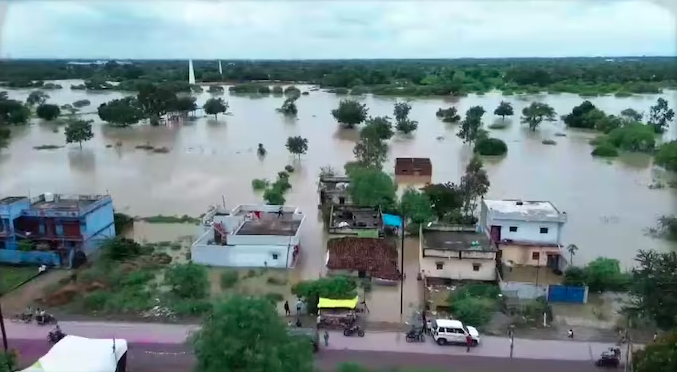
At least 56 people have lost their lives across Uttar Pradesh in rain and storm, related incidents following an intense three, day spell of heavy rainfall that lashed large parts of the state, officials said. The deaths were reported from multiple districts, with drowning, house collapses, lightning strikes and falling debris among the primary causes as waterlogged conditions and gusty winds disrupted normal life. Several others have been injured, and authorities fear the toll could rise as reports continue to arrive from remote and flood, prone areas. The state government has directed district administrations to remain on high alert, and relief and rescue operations are underway in the worst, affected regions. The spell, which persisted for roughly 72 hours, has left behind a trail of destruction, submerging low, lying localities and damaging crops, roads and power infrastructure.
The heavy downpour has pushed river levels sharply higher, with the Ghagra and Rapti rivers, both tributaries of the Ganga in the eastern part of the state, flowing above or close to the danger mark at several points. The Ghagra, a major contributor to the flood regime of eastern Uttar Pradesh, swells rapidly when catchment areas in neighbouring Nepal and the Himalayan foothills receive sustained rainfall, and the Rapti has a long history of inundating settlements along its banks. Districts such as Gorakhpur, Ayodhya, Barabanki, Gonda, Basti and Shravasti are particularly vulnerable because they lie in the fertile but flood, prone alluvial plains drained by these rivers. The state's disaster management machinery has been placed on alert, with the National Disaster Response Force and Provincial Armed Constabulary teams positioned for possible deployment.
While the state has not released a comprehensive district, wise breakdown in full detail, official accounts indicate that a substantial number of deaths resulted from drowning in swollen streams and ponds, and from the collapse of mud walls and old structures weakened by continuous rain. Lightning strikes during thunderstorms are also reported to have claimed lives in rural areas, where people working in fields or shelters are especially exposed. District magistrates have been instructed to ensure prompt payment of ex, gratia compensation to the families of the deceased, as per norms set by the state disaster relief framework. Relief material, including food packets, dry rations and tarpaulin sheets, is being distributed in affected villages, though officials acknowledge that reaching some cut, off habitations remains a challenge.
Political attention has swiftly turned to the response effort, with opposition parties questioning whether the state administration was adequately prepared for the sudden severity of the weather system. In Uttar Pradesh, where flood management is a recurring and politically sensitive subject, such disasters often prompt demands for better embankments, drainage and early, warning systems. Chief Minister Yogi Adityanath has been reviewing the situation with senior officials, and ministers have been deputed to visit affected districts to oversee relief. Farmers in particular face deep anxiety, as standing crops of paddy and other monsoon, dependent produce in low, lying fields are at risk of being submerged, threatening incomes in a predominantly agrarian region.
The episode fits a broader pattern of increasingly erratic and intense monsoon activity over northern India in recent years, with short but extreme rain events causing damage even in areas not traditionally classified as flood zones. Climate and hydrology experts have long warned that unplanned urban expansion, encroachment on natural drainage channels and silting of rivers amplify the impact of heavy rainfall, turning routine monsoon spells into disasters. Uttar Pradesh, India's most populous state, is especially exposed because a large share of its population depends directly on agriculture and lives in rural settlements with limited resilient infrastructure. The simultaneous pressure of rising rivers and saturated ground means that even moderate additional rainfall could aggravate conditions in the coming days.
Uttar Pradesh has a long and painful record of monsoon calamities, with the eastern districts repeatedly bearing the brunt of flooding in the Ghagra, Rapti, Gandak and bordering river systems. In past years, extensive inundation in the Terai and Purvanchal regions has displaced lakhs of people, damaged standing crops and disrupted transport links for weeks at a time. The recurrence of such events has shaped the state's disaster, response architecture, including the creation of flood control rooms, embankment programmes and evacuation protocols, though critics argue implementation on the ground remains uneven. The current incident once again highlights the gap between early, warning capability and last, mile preparedness in vulnerable blocks. It also underscores the human cost of extreme weather in a region where livelihood options outside farming remain limited.
With the India Meteorological Department indicating the possibility of further rainfall over parts of the state and its catchment areas, authorities are bracing for continued pressure on the Ghagra, Rapti and other rivers. Administrations in vulnerable districts are expected to step up patrolling of embankments, relocate families from the lowest, lying settlements to relief camps, and maintain round, the, clock monitoring of water levels. The state government is likely to release a consolidated assessment of damage and compensation once reports from all districts are compiled, and demands for enhanced central assistance may follow if the flood situation worsens. For the thousands of families already affected, the immediate priorities remain safety, shelter and the restoration of essential services. How effectively the state manages the next phase of this monsoon emergency will determine how heavy the final cost, in both lives and livelihoods, turns out to be.